Prioritizing Well-Being: Self Care, Sleep, Nutrition, and Daily Habits for a Healthier Life
Well-being rarely falls apart all at once. More often, it erodes through skipped meals, short nights, tense shoulders, constant stress, and the quiet belief that rest has to be earned. A healthier life starts with a different mindset: self-care is not a reward for getting everything done. It is the foundation that helps people think clearly, handle pressure, connect with others, and stay physically steady over time.
Prioritizing well-being does not require an expensive routine or a total lifestyle overhaul. It often begins with small daily choices repeated with care: sleeping enough, eating in a way that supports energy, moving the body, pausing under stress, and speaking to yourself with the same patience you would offer someone you love. It is within those small daily choices in one's routine that builds a healthier life over time.

A self-care mindset changes how daily choices feel
Self-care is often presented as something separate from real life, like a spa day, a weekend break, or a purchase. Those things can be enjoyable, but the deeper practice is more practical.
A self-care mindset asks, “What helps me stay well enough to live my life with steadiness?”
That question can shift the tone of everyday decisions. Going to bed on time becomes a way to protect tomorrow. Eating lunch becomes a way to avoid an energy crash. Taking a walk becomes a reset for the nervous system. Saying no becomes a way to preserve health, not disappoint people. A self-care mindset also reduces the all-or-nothing trap. Missing one workout does not mean the week is ruined. Eating takeout does not cancel every healthy choice. Feeling stressed does not mean personal failure. Well-being is built through patterns, not perfection.
A simple way to practice this mindset is to check in once or twice a day:
What does my body need right now?
What would make the next hour easier?
Am I pushing through something that needs attention?
What is one small choice that supports future me?
These questions work because they are realistic. They do not demand a dramatic life change. They create a pause, and that pause helps people respond instead of running on autopilot.
Quality sleep is the foundation for better days
Sleep affects nearly every part of well-being. It supports concentration, immune function, mood regulation, appetite hormones, learning, and physical recovery. Skip enough of it, and even simple tasks can feel harder.
Good sleep does not mean sleeping perfectly every night. It means creating conditions that make restful sleep more likely.
Build a sleep rhythm your body can trust
The body responds to rhythm. Waking and sleeping at roughly consistent times helps regulate the internal clock. This does not have to be rigid, but large swings between weekdays and weekends can make Monday feel like jet lag.
A supportive sleep routine might include:
A consistent wake time most days
Morning light exposure, especially outdoors when possible
A calming wind-down period before bed
A cool, dark, quiet sleep environment
Limited caffeine later in the day
Less screen stimulation close to bedtime
The wind-down at bed time matters because the brain does not switch from full speed to deep sleep on command. Reading, dimming lights, stretching, gentle music, or a warm shower can signal that the day is ending.
Protect sleep from “just one more thing”
Many people lose sleep in small pieces. One more episode. One more email. One more chore. One more scroll. The problem is not one night of staying up late. The problem is when sleep becomes the thing that absorbs every overflow.
A useful boundary is a “bedtime alarm.” Set a reminder 30 to 60 minutes before sleep, not to go to bed immediately, but to start closing the day. Put away food prep, plug in devices outside the bed if possible, and choose a short calming routine. Better sleep often begins before bedtime. It begins with giving the evening a clear finish line.
Nutrition supports energy, mood, and long-term health
Healthy eating does not need to be complicated. At its core, it means giving the body enough steady fuel, enough nutrients, and enough flexibility to make the pattern sustainable.
Food affects blood sugar, digestion, energy, and mood. Long gaps without eating can leave people irritable, foggy, or more likely to grab whatever is quick. Meals built around protein, fiber-rich carbohydrates, healthy fats, and colorful plants tend to support steadier energy.
Aim for balance more often than rules
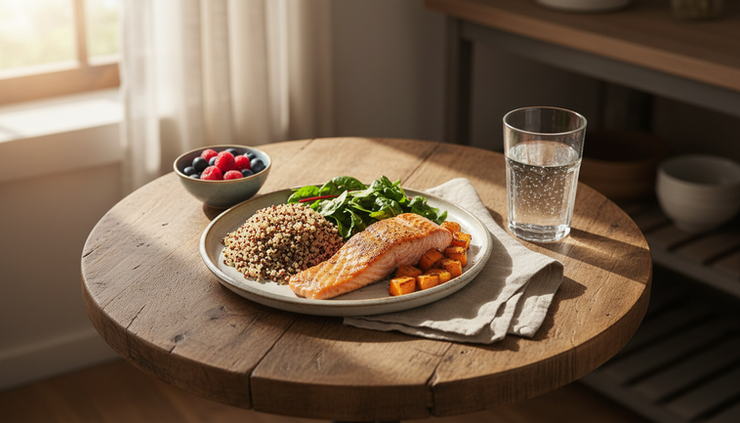
A simple plate can include:
Protein such as eggs, fish, chicken, tofu, beans, lentils, yogurt, or lean meat
High-fiber carbohydrates such as oats, brown rice, potatoes, fruit, beans, or whole-grain bread
Healthy fats such as avocado, nuts, seeds, olive oil, or nut butter
Vegetables or fruit for vitamins, minerals, and fiber
Water or another low-sugar drink for hydration
This does not mean every meal must look perfect. A frozen meal with added vegetables can count. A sandwich with fruit can count. Leftovers can count. The goal is to make nourishing choices easier, not turn eating into a test.
Make the environment do some of the work
Willpower is unreliable when people are tired and hungry. Environment helps.
Keep a few simple options ready:
Washed fruit
Greek yogurt or cottage cheese
Nuts or trail mix
Hummus and vegetables
Hard-boiled eggs
Soup or chili portions
Precooked grains
Canned beans or tuna
When nourishing food is visible and easy to reach, healthy eating becomes less dependent on motivation.
Regular movement keeps the body and mind more resilient
The body was made to move. Regular physical activity supports heart health, muscle strength, balance, sleep quality, metabolism, and mood. It also gives stress a physical outlet. Exercise does not have to mean a gym membership or an intense program. Walking counts. Dancing in the kitchen counts. Gardening counts. Body strength training counts. Short movement breaks count.
The best form of movement is the one that fits into real life often enough to repeat.
Use a mix of movement types
A well-rounded routine includes three broad categories:
Cardio movement
Walking, cycling, swimming, hiking, dancing, or jogging support heart and lung health.
Mobility movement
Stretching, yoga, tai chi, and gentle range-of-motion work help reduce stiffness and improve ease of movement.
Strength movement
Squats, lunges, pushups, resistance bands, or weights help maintain muscle and bone strength.
Daily life movement
Taking stairs, carrying groceries, cleaning, and standing breaks add up over the week.
For motivation, connect movement to an immediate benefit. Instead of thinking only about future health, notice what happens after 10 minutes of walking: warmer muscles, clearer thoughts, deeper breathing, and less restlessness.
Start smaller than you think you should
Many exercise plans fail because they begin too aggressively. If a routine leaves someone exhausted, sore, or discouraged, it becomes easy to quit.
Start with a level that feels almost too easy:
Walk for 10 minutes after lunch
Do five squats while coffee brews
Stretch for three minutes before bed
Use a resistance band twice a week
Take a gentle bike ride on Saturday morning
Small movement repeated consistently beats a difficult plan that fades after one week.
Stress management is a daily practice, not a last resort
Stress is part of life, but constant stress takes a toll. It can affect sleep, digestion, muscle tension, patience, cravings, immune function, and emotional balance. The goal is not to avoid every stressful experience. The goal is to help the body recover after stress and prevent tension from becoming the default state.
Use quick resets during the day
Brief practices can help tell the nervous system that it is safe to settle.
Try one of these:
Box breathing Inhale for four counts, hold for four, exhale for four, hold for four. Repeat for one to three minutes.
Longer exhale breathing Inhale gently, then exhale a little longer than the inhale. This can feel calming because the exhale is linked with relaxation.
Grounding through the senses Name five things you see, four things you feel, three things you hear, two things you smell, and one thing you taste.
A short walk outside Light, movement, and a change of scenery can help interrupt rumination.
A one-minute body scan Notice the jaw, shoulders, hands, stomach, and feet. Soften one area at a time.
None of these erases hard circumstances. They create space inside them.
Practice self-compassion when life feels messy
Self-compassion is not self-pity and it is not making excuses. It means responding to difficulty with honesty and kindness rather than shame. Self-compassion is recognizing suffering, remembering that struggle is part of being human, and offering kindness to yourself. Research has linked self-compassion with greater emotional resilience, lower self-criticism, and healthier coping.
A practical self-compassion phrase might sound like this:
“This is hard right now. Other people struggle too. I can take one caring step.”
That one caring step might be drinking water, asking for help, stepping outside, rescheduling a non-urgent task, or going to bed instead of pushing harder. Self-kindness is not weakness. It is a skill that helps people recover and keep going.

Gratitude and positivity can support emotional and physical health
Gratitude and positivity are sometimes misunderstood as pretending everything is fine. Real positivity does not deny pain, grief, stress, or injustice. It makes room for what is good alongside what is hard.
Psychological research suggests that gratitude practices can improve well-being for many people. Studies in positive psychology, have found that regularly noticing and recording things one is grateful for can support more positive mood and life satisfaction. Gratitude may also affect physical health indirectly. When people feel more hopeful or connected, they may sleep better, move more, reach out to others, and handle stress with less reactivity. The emotional and physical systems are closely connected.
Keep gratitude specific and honest
A gratitude practice works best when it feels real. Instead of forcing a long list, try writing three specific notes:
Something that made today easier
Someone who helped, even in a small way
A moment of comfort, beauty, humor, or relief
Examples might include warm sunlight on the kitchen floor, a friend’s text, a good stretch, a meal that tasted satisfying, or a dog leaning against your leg.
For people going through a painful season, gratitude can be even simpler: “I got through today,” “I had clean water,” or “I took my medication.” That counts.
Simple stretching routines can ease daily tension
Daily activities create predictable tension patterns. Looking down at a phone tightens the neck. Sitting for long periods stiffens the hips. Driving can tense the shoulders. Standing all day can fatigue the calves and lower back.
Stretching is not a cure-all, and pain should never be forced through. But gentle mobility can reduce stiffness, increase body awareness, and help the nervous system slow down. Move slowly, breathe steadily, and stop if a movement causes sharp pain, numbness, or dizziness.
A five-minute desk and screen reset
Use this routine after a long period of sitting, studying, driving, or looking at screens.
Neck release Sit or stand tall. Let the right ear move toward the right shoulder. Hold for 20 seconds, then switch sides.
Shoulder rolls Roll shoulders up, back, and down 10 times. Reverse direction for 10 more.
Chest opener Clasp hands behind the back or hold a towel. Gently lift the chest and draw shoulder blades together. Hold for 20 to 30 seconds.
Seated twist Sit tall, place one hand on the opposite thigh, and rotate gently. Hold for 20 seconds each side.
Wrist stretch Extend one arm forward with palm up. Gently draw fingers back with the other hand. Switch sides.
A five-minute evening tension release
This works well before bed or after a long day.
Child’s pose Kneel and fold forward with arms extended or resting by the sides. Breathe for 30 to 60 seconds.
Cat-cow On hands and knees, alternate rounding and arching the back. Move slowly for 8 to 10 rounds.
Low lunge Step one foot forward and lower the back knee if comfortable. Feel the stretch through the front of the hip. Hold 30 seconds each side.
Supine hamstring stretch Lie on your back and raise one leg, holding behind the thigh. Keep the knee slightly bent if needed. Hold 30 seconds each side.
Legs up the wall Rest legs against a wall or on a couch. Breathe slowly for one to two minutes.

Make well-being easier to choose
A healthier life becomes more likely when supportive habits are simple, visible, and connected to existing routines.
Try pairing new habits with something already established:
Stretch after brushing your teeth
Drink water before morning coffee
Take a walk after lunch
Prep breakfast while cleaning up dinner
Write one gratitude note before turning off the light
Put workout clothes near the bed
Set a bedtime reminder when the evening begins
It also helps to choose one focus at a time. Sleep, nutrition, movement, stress management, self-compassion, and gratitude all matter, but trying to change everything at once can create pressure. Choose the habit that would make the biggest difference this week.
A good starting point might be:
Go to bed 20 minutes earlier
Add protein to breakfast
Walk for 10 minutes daily
Stretch your neck and shoulders each afternoon
Write down one thing that went right
Use one calming breath before responding to stress
Well-being grows through repetition. Some days will be easier than others. The goal is to return, gently and often, to choices that support health.
Prioritizing well-being is not selfish or unrealistic. It is a steady commitment to living with more care for the body, more patience for the mind, and more respect for the life being lived right now. Start with one small habit today, then let that habit become proof that your health deserves a place on your calendar, in your home, and in your daily decisions.


Comments